Posts

Showing posts with the label Cheap

500W Cheap 12V to 220V inverter Circuit Diagram

Image
Build a simple 500W Cheap 12V to 220V inverter Circuit Diagram.  In this circuit 4047 is use to generate the square wave of 50hz and amplify the current and then amplify the voltage by using the step transformer. 500W Cheap 12V to 220V inverter Circuit Diagram How to calculate transformer rating The basic formula is P=VI and between input output of the transformer we have Power input = Power output For example if we want a 220W output at 220V then we need 1A at the output. Then at the input we must have at least 18.3V at 12V because: 12V*18.3 = 220v*1 So you have to wind the step up transformer 12v to 220v but input winding must be capable to bear 20A.   Source: www.circuitsproject.com

Amplifier simple easy and cheap with IC TA7368P

Image
Indeed , this amplifier is suitable known as the title above. Viewed from the schematic alreaady seen that this amplifier circuit requires little components and parts were cheap. This amplifier requires 1 piece of IC TA7368P is manufactered by TOSHIBA is the price too low, then in addition to IC amplifier requires 3 components elco capacitor whose value is not too big. Maybe if you make this amplifier circuit, the total price of all must not be more than $ 1. This amplifier only has more than 1W output, perhaps because it has little strengthening it so that the output is released is very small. But to make this is quite easy and not too costly. Part List : Capacitor C1 = 100 uF C2 = 100uF C3 = 470uF IC IC1 = TA7368P Good Luck :)

Cheap and Simple Gate Alarm Circuit Diagram

Image
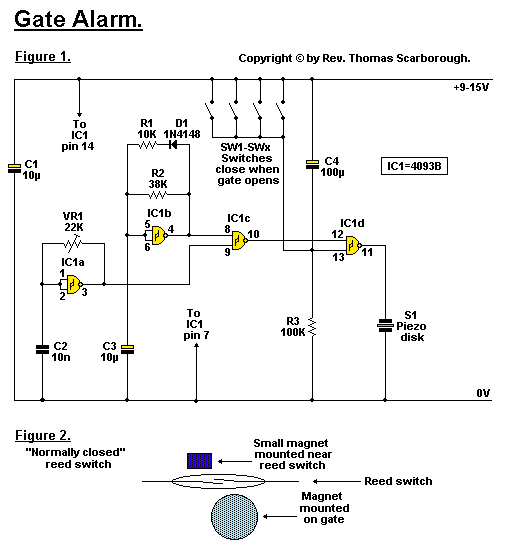
This is the Cheap and Simple Gate Alarm Circuit Diagram. A cheap and simple gate alarm made from a single CMOS Integrated Circuit.  Cheap and Simple Gate Alarm Circuit Diagram Circuit Notes Figure 1 represents a cheap and simple Gate Alarm, that is intended to run off a small universal AC-DC power supply. IC1a is a fast oscillator, and IC1b a slow oscillator, which are combined through IC1c to emit a high pip-pip-pip warning sound when a gate (or window, etc.) is opened. The circuit is intended not so much to sound like a siren or warning device, but rather to give the impression: "You have been noticed." R1 and D1 may be omitted, and the value of R2 perhaps reduced, to make the Gate Alarm sound more like a warning device. VR1 adjusts the frequency of the sound emitted. IC1d is a timer which causes the Gate Alarm to emit some 20 to 30 further pips after the gate has been closed again, before it falls silent, as if to say: "I'm more clever than a simple on-off device....

Cheap Bicycle Alarm Schematics Circuit Diagram

Image
The author wanted a very cheap and simple alarm for some of his possessions, such as his electrically assisted bicycle. This alarm is based on a cheap window alarm, which has a time-switch added to it with a 1-minute time-out. The output  pulse of the 555 replaces the reed switch in the window alarm. The 555 is triggered by a sensor mounted near the front  wheel, in combination with a magnet that is mounted on the spokes. This sensor and the magnet were taken from a cheap bicycle computer.  Circuit diagram : Cheap Bicycle Alarm Circuit Diagram The front wheel of the bicycle is kept unlocked, so that the reed  switch closes momentarily when the wheel turns. This  triggers the 555, which in turn activates the window alarm. The circuit around the 555 takes very little current and can  be powered by the batteries in the window alarm.  There  is just enough room  left inside the enclosure of the window  alarm to mount the time-switch inside ...

Cheap and easy DIY guitar nut lubricant

Image
Yeah, that’s right, “nut lubricant” (sometimes known as nut sauce). Get all your giggling out of the way before we continue. So you know how sometimes you’re tuning up your guitar and you hear this pinging noise and the string suddenly “jumps” up in pitch? That’s caused by the string getting stuck (sometimes known as "binding") in the nut slots. You can also encounter it when using a tremolo. My usual fix for this is to widen the nut slots slightly using nut files. However, today I’m going to show you another solution that can often work instead. We’re going to make a lubricant to put in the nut slots. This is especially useful for tremolo-equipped guitars. Here's our patient for today. It's a late 80's Fernandes "Limited Edition" Strat. Beautiful guitar, but a terrible case of "pinging" at the nut. We don’t need much for this, just some graphite (courtesy of a pencil lead) and something to hold the powder together (petroleum jelly). Some sandp...