Posts

Showing posts with the label RIAA

Making an RIAA phono preamp
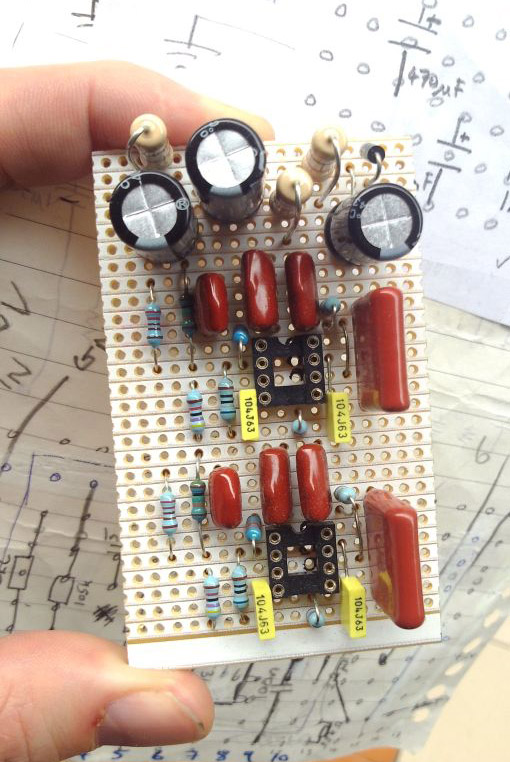
Image
Before we start today's blog post, I think I really need to clarify what we’re discussing. I’ve recently got back into vinyl in a big way. Part of the reason for this is the fantastic “Vinyl Decision” in Taipei, run by a couple of very fine gentlemen by the names of Mark and Terry ( https://www.facebook.com/VinylDecision / http://www.vinyldecision.com/ ). If you're in Taipei, and like music, pay them a visit. A recent purchase from there brought back memories of trying again, and again (and again) to play guitar like my guitar heroes as a teenager in the 1980s. In fact, vinyl is making quite a comeback worldwide. A lot of people are realizing that digital versions just lack some of the personality that vinyl can provide. Many of them are buying old record players/turntables and wiring them up to their modern amps. However, they are often disappointed to find that the output audio is very quiet and lacking bass. This is because records are/were recorded using a very specific f...

Multimedia RIAA Preamplifier Circuit Diagram

Image
Even if a large number of album titles once available on vinyl are now, little by little, being proposed as CDs, not all are available and far from it. You may have treasures in your collection that you would like to burn on CDs. First, preserving a CD is easier than preserving a vinyl record, and second, we have to admit that turntables are disappearing, even on fully-equipped Hi-Fi systems. From a point of view of software and PCs, converting from vinyl to CD is not a problem. A large number of programs, whether paid for freeware, are available to re-master vinyl records with varying degrees of success and to eliminate pops, crackles and other undesirable noises. All of these programs work with the sound card of your PC and that, admittedly, is where the problem starts. Most high-quality turntables are equipped with a magnetic cartridge which typically delivers just a few mV. The cartridge signal requires a correction of a specific frequency, called RIAA correction. If our older read...