Posts

Showing posts with the label the

Voltage Controlled Switch using the 555

Image
This electronic voltage controlled switch circuit diagram project make a very easy. In this electronic project circuit the 555 timer is used in a novel way, as a voltage controlled switch.  Voltage Controlled Switch Circuit Diagram: Notes: The old and omnipresent NE555 can be very good at something it was not meant for: driving relays or other loads up to 200 mA. The picture shows an example circuit: if the input level rises over 2/3 of the supply voltage - it will turn on the relay, and the relay will stay on until the level at the input drops below one third of the supply voltage. If the relay and D1 were connected between pin 3 and ground, the relay would be activated when the input voltage drops below one third, and deactivated when the input voltage goes over two thirds of the supply voltage. It is also a nice advantage that the input requires only about 1 uA, which is something bipolar transistors can't compete with. (This high impedance input must not be left open.) A large ...

Selecting the Right Speakers Surround

When it comes to your surround sound or home theater system, the quality of your speakers can really make or break the overall experience. Good quality speakers are one of, if not, the most important components when it comes to your home theater and surround sound system.  You need to take action from the very beginning in order to make sure that you are not getting substandard speakers for your entertainment system whether your surround sound system is going to be used for your television viewing, home theater, music enjoyment, or to enhance your gaming experience on your personal computer the quality of the speakers will have a huge impact on how much you enjoy your system. The problem is that most people do not even know where to begin when it comes to selecting and purchasing speakers. There are a few guidelines you can follow when making your decisions about speakers that will help you make better buying decisions in order to get higher quality speakers (budget allowing of cou...

A Doorbell for the Deaf

Image
This circuit provides a delayed visual indication when a door bell switch is pressed. In addition, a DPDT switch can be moved from within the house which will light a lamp in the door bell switch. The lamp can illuminate the words "Please Wait" for anyone with walking difficulties.  A Doorbell for the Deaf Circuit Diagram : Notes : The circuit uses standard 2 wire doorbell cable or loudspeaker wire. In parallel with the doorbell switch, S1, is a 1N4001 diode and a 12 volt 60mA bulb. The bulb is optional, it may be useful for anyone who is slow to answer the door, all you need to do is flick a switch inside the house, and the bulb will illuminate a label saying Please Wait inside the doorbell switch or close to it. The double pole double throw switch sends the doorbell supply to the lamp, the 22 ohm resistor is there to reduce current flow, should the doorbell switch, S1 be pressed while the lamp is on. The resistor needs to be rated 10 watts, the 0.5 Amp fuse protects agains...

Para saki the QRP Transceiver fact Diodes Circuit Diagram

Image
This circuit is a dream of 40 years was conducted, a transceiver QRP (low power) done without transistors, IC or valves, its creator just used diodes. The receiver has little gain, but works well for strong signals via the audio amplifier which is very effective.I believe this transceiver is at least very curious, though precarious it sure works and shows that the electron has no limits. Para-saki the QRP Transceiver fact Diodes Circuit Diagram Parasaki the QRP Transceiver fact Diodes Circuit Diagram

The network got a photo of the first Microsoft Lumia smartphone

Image
      The site of the certification authorities of China TENAA image appeared first smartphone under the brand Microsoft Lumia. Model RM-1090 is probably the enlarged version of Lumia 530 with support for two SIM-cards and, most likely, the entry-level specifications. According to unofficial data, the screen resolution of the smartphone will be 960 × 540 pixels. In October, Microsoft has disclosed how it will look new brand its smartphones, and also reported that the appearance of the first devices in the offing. Despite the rebranding, the company will continue to support and sell existing smartphones Nokia Lumia. Subsequently disappear from the market and the ordinary mobile phones under the brand Nokia: Microsoft Corporation owns the rights to the trademark for use in such devices.

Hofner Colorama II restoration project part 7 applying the decal and lacquering the neck

Image
In the previous post, we set about making a replacement decal for the neck on this vintage Hofner Colorama II. Before we lacquer the neck, we need to apply the decal. The decal is printed on special laser waterslide decal paper. This paper just prints on a standard laser printer. It’s also possible to get inkjet waterslide decal paper, but just note that an inkjet printout requires that you spray a layer of lacquer over the printed decal before you let it anywhere near water. So first we put some not-too-hot/not-too-cold water in a little dish and place the decal in there, making sure to submerge it. After a minute or so you will notice that it starts to separate from the paper. You can test this by seeing if it will slide around on the paper, but don’t force it too much. While we are waiting for the decal to reach this separation stage, it’s a good idea to spread just a little bit of water on the area where we will apply the decal. This helps to prep the surface for what is to come. O...

Demystifying The Use of Table Pointer in SPWM Application in Sine Wave Inverter

Image
I have previously written quite a few articles on sinusoidal pulse width modulation (SPWM). I've discussed about how to generate the sine table, how to implement it, how to practically generate the SPWM signals (with example code) and also how to implement feedback with simple sine table manipulation with table pointer instead of complex PID control. All these methods have one thing in common regarding the implementation - use of the sine table and its control with the table pointer. Whether you use or implement feedback or not, the table pointer is used to access and retrieve values from the sine table. Before reading or going through this article, I suggest you go through these first: Tutorial (Click here to open tutorial): Generation and Implementation of Sine Wave Table   Article (Click here to open article): Smart Sine – Software to generate sine table Article (Click here to open article): Generation of sine wave using SPWM in PIC16F684 It took quite a while for me to unde...

Oppo preparing the announcement of two smartphones

Image
As you know, Oppo now preparing to release its new flagship smartphone N3, periodically fueling interest for the upcoming announcement of the teaser images. Presentation of the device to be held on October 29, and while the company released a new teaser, which Oppo N3 like "peeking" from behind the scenes. However, this is not the most interesting: it can be seen next corner another device, which is virtually invisible, and consider what it is until you can not. Does this mean that at the same time with the Oppo N3 will be announced another novelty? In any case, regarding the second unit Oppo any data yet. But information about the Oppo N3 already enough. The device is rumored to be equipped with a 5.9-inch touch screen with a resolution of 1920 x 1080 pixels, built on a quad-core Qualcomm Snapdragon processor with a clock frequency of 805 GHz and 2.7 Adreno 420 GPU, equipped with 3 GB of RAM and runs on Android 4.4 KitKat. The most interesting feature of this model is t...

The 555 DC to AC Inverter Schematic

Image
This DC-to-AC inverter schematic produces an AC output at line frequency and voltage. The 555 is configured as a low-frequency oscillator, tunable over the frequency range of 50 to 60 Hz by Frequency potentiometer R4.  The 555 DC-to-AC Inverter Schematic The 555 feeds its output (amplified by Q1 and Q2) to the input of transformer T1, a reverse-connected filament transformer with the necessary step-up turns ratio. Capacitor C4 and coil L1 filter the input to T1, assuring that it is effectively a sine wave. Adjust the value of T1 to your voltage. Error fix: Pin 7 and 2 were reversed. Original pinout was correct. Parts List: R1 = 10K R2 = 100K R3 = 100 ohm R4 = 50K potmeter, Linear C1,C2 = 0.1uF  C3 = 0.01uF C4 = 2700uF Q1 = TIP41A, NPN, or equivalent transistor Q2 = TIP42A, PNP, or equivalent transistor  L1 = 1uH T1 = Filament transformer, your choice The output (in watts) is up to you by selecting different components. Input voltage is anywhere from +5V to +15Volt DC, ad...

Photo Tuning for the iPhone an overview of removable lenses and lens

Image
iPhone has long evolved from multifunctional gadget smartphone with great potential. Engineers and designers are creating more and more new devices for its transformation. With special docking stations, iPhone can be turned into a retro-radio from the 70s or a full-fledged gaming console. He may even become a thermometer. Yet the most common feature is, of course, after calling themselves remains photograph. iPhone is easy to replace a simple digital cameras. Expanding the field of creativity, using removable lenses, and other devices. High-quality images with the iPhone - easily If the quality of the pictures for you coming to the fore and you want to make great pictures, then do without the removable lenses, you will be impossible. Fortunately for the iPhone developed them quite a lot. We represent several options. 8x zoom closer to the action there is no difficulty. The images are crisp, clear. The kit included a mini-tripod for more convenient use of your iPhone. It includes lens F...

The Portable Solar Lantern

Image
This portable solar lantern circuit uses 6 volt/5 watt solar panels are now widely available. With the help of such a photo-voltaic panel we can construct an economical, simple but efficient and truly portable solar lantern unit. Next important component required is a high power (1watt) white LED module. When solar panel is well exposed to sunlight, about 9 volt dc available from the panel can be used to recharge a 4.8 volt /600 mAh rated Ni-Cd batterypack. Here red LED (D2) functions as a charging process indicator with the help of resistor R1. Resistor R2 regulates the charging current flow to near 150mA. Solar Lantern Circuit Schematic Assuming a 4-5 hour sunlit day, the solar panel (150mA current set by the charge controller resistor R2) will pump about 600 – 750 mAh into the battery pack. When power switch S1 is turned on, dc supply from the Ni-Cd battery pack is extended to the white LED (D3). Resistor R3 determines the LED current. Capacitor C1 works as a buffer. Note: After con...

Parts of the UPS Uninterruptible Power Supply

Uninterruptible Power Supply UPS is basically composed of three main components, namely: 1) Rectifier-Charger This section is used to transfer circuit and battery charging. Rectifier-charger circuit block is going to supply the power needed by the inverter under full load and at that time to maintain the charge in the battery. Besides these blocks must have the ability to drain the power output of 125-130%. Characteristics of the batteries also need to be taken into account in its charger circuit design because if a rechargeable battery with a current that exceeds the capacity limit will be able to shorten the life of the battery. U sually for a battery charging current to the UPS is 80% of current conditions issued by the batteries at full load. Limitation of a UPS system is good by the standards of NEMA - National Electical Manufacturer Association - is able to provide 100% power continuously (continuous load) and 2 hours at 125% load without a decrease in performance (damage). The...

Hofner Colorama II restoration project part 3 re fretting the guitar neck

Image
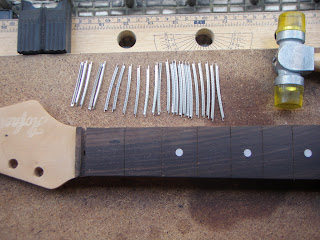
In the last blog post, we stripped down and de-fretted a vintage Hofner Colorama II neck. Today we’ll re-fret it. First of all, we need to do some initial preparation, so we lay the neck out on its jig just like in the previous post and then sort out the fret wire. These frets have been bought pre-cut and pre-radiused. They’re not all the same length, so we need to sort them in order of shortest to longest. Here we’ve punched holes (don’t use the frets to do this!) in an empty cardboard box and placed the frets in them in the correct order. Next thing we need to do is clean all of the dust, etc., out of the fret slots. A thin craft knife will suffice for this, but do it in the opposite direction to the knife edge (in other words, if the blade is pointing forwards, then pull the knife backwards). Remember, we’re not actually cutting anything here, just pushing all of the dust out of the slots. Next we take our shortest fret and do a test fitting in the first fret slot. Uh-oh, it seems t...

The detailed internal wiring for the sample DB and MCB and RCD units used

Image

The damage Horizontal LG TV

Image
Often find LG TV is switched off completely. After checking it Hor short TR / koslet so that all the inverter output voltage drop. Start with the appointment of TR page and check the voltage and turns back to normal. Do not always replace with a new TR because TR surely you will lose because they will surely be broken again, if immediate profits and normal life. After checking on the block capacitor Horizontal out that there was a rather plump and lifted it after it is dry there is no value of the capacitance. LG TV Capacitor is located on the collector TR Hor bypassed to ground which is parallel with the diode. For the slim LG 21 "inch typically use 2kV 183j (18n 2kV) for the black pearl 29" using 103j2kv (10N 2kV). After replacement of capacitor TSB and TR Hor who just started a TV and Direct TV was OK. 've Also found a balck pearl TV LG 29 "wide image conditions and so OSD is only half visible. As usual checks are still in the horizontal section. Initially thought...

Maximum power transfer

Image
In DC circuits this theorem state that the source can transfer maximum power when the total resistance viewed from the load is equal to the value of the resistance of that load.  Applications of Maximum Power Transfer In communication system, maximum power transfer is always sought. For example in public address system, the circuit is adjusted for maximum power transfer by making load resistance (speaker) equal to the source resistance (amplifier). When source and load have the same resistance, they are said to be matched. In car engines, the power delivered to the starter motor of the car will depend upon the effective resistance of the motor and the internal resistance of the battery. If the two resistances are equal, maximum power will be transferred to the motor to turn to the engine.   Proof of Maximum Power Transfer At this point the simple circuit is can be a resemblance of a Thevinin's Circuit diagram where the internal resistance Ri similar to the Theveni...

RoomMote – Control the color and sockets of your Room

Image
That is how a lone mosquito irritates you in the middle of the night trying to convince you that his lullaby is helpful. Insignificant or not, But truly that is the underlying inspiration for this project. The Mosquito repellents have this obnoxious smell that I would not like to sleep in and these loner mosquitoes who just piss me off by buzzing in the ear, you have to choose a lesser evil. Obviously, I turned ON the repellent and in a while it goes off but the smell starts building up and I am too lazy to turn it back OFF, leaving the warmed blanket on a chilly Delhi December Night. The nocturnal dilemma . [ ]

Modalities of Using the PIC 16F877A CCP Module Compare Section

Image
The CCP module is one of the most important modules in the PIC microcontroller. While being extremely important, it is not very difficult to use. Here I will show you how to use the compare section of the CCP (Compare, Capture, Pulse Width Modulation) module of the PIC16F877A. You can use this concept for any PIC with a CCP/ECCP module There are 2 modules associated with the compare section – the CCP module which we’ll use for the compare function, and the Timer 1 module. The function of the compare module is to compare (obviously, as the name suggests) the value of the CCPR1 register against the Timer 1 value. The CCPR1 register is actually composed of two 8-bit registers that together form a 16-bit register. The high 8-bits – the high byte – make up the CCPR1H register and the low 8-bits – the low byte – make up the CCPR1L register. For example, if the value of CCPR1H is 30 and the value of CCPR1L is 47, what is the value of the 16-bit CCPR1 register? Solution: CCPR1H = 30 = 0x1E CC...