Posts

Showing posts with the label guitar

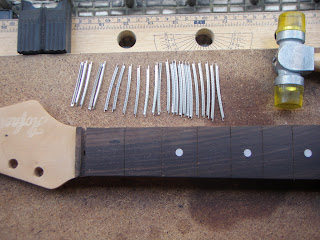
Hofner Colorama II restoration project part 3 re fretting the guitar neck
Image
In the last blog post, we stripped down and de-fretted a vintage Hofner Colorama II neck. Today we’ll re-fret it. First of all, we need to do some initial preparation, so we lay the neck out on its jig just like in the previous post and then sort out the fret wire. These frets have been bought pre-cut and pre-radiused. They’re not all the same length, so we need to sort them in order of shortest to longest. Here we’ve punched holes (don’t use the frets to do this!) in an empty cardboard box and placed the frets in them in the correct order. Next thing we need to do is clean all of the dust, etc., out of the fret slots. A thin craft knife will suffice for this, but do it in the opposite direction to the knife edge (in other words, if the blade is pointing forwards, then pull the knife backwards). Remember, we’re not actually cutting anything here, just pushing all of the dust out of the slots. Next we take our shortest fret and do a test fitting in the first fret slot. Uh-oh, it seems t...

Cheap and easy DIY guitar nut lubricant

Image
Yeah, that’s right, “nut lubricant” (sometimes known as nut sauce). Get all your giggling out of the way before we continue. So you know how sometimes you’re tuning up your guitar and you hear this pinging noise and the string suddenly “jumps” up in pitch? That’s caused by the string getting stuck (sometimes known as "binding") in the nut slots. You can also encounter it when using a tremolo. My usual fix for this is to widen the nut slots slightly using nut files. However, today I’m going to show you another solution that can often work instead. We’re going to make a lubricant to put in the nut slots. This is especially useful for tremolo-equipped guitars. Here's our patient for today. It's a late 80's Fernandes "Limited Edition" Strat. Beautiful guitar, but a terrible case of "pinging" at the nut. We don’t need much for this, just some graphite (courtesy of a pencil lead) and something to hold the powder together (petroleum jelly). Some sandp...

Funk Twang Guitar Effect Box Circuit Diagram

Image
This is an audio effect circuit that give extra oscillation to your guitar, percussive, or semi percussive instruments, you can call it a funk box. This  guitar effect circuit is basically a damped oscillator that is set slightly below its critical oscillation point.   The oscillator part is constructed by feeding back the output signal through a bandpass circuit, with the center frequency is adjusted by potentiometer R7 to add an extra “twang” , adjustable from low to high pitched timbre. Potentiometer R4 is used to adjust the gain of the oscillator, should be set to damp the oscillation at the desired decay time.   To adjust it, turn the knob slowly until a steady oscillation occurs, and turn back slightly just before it happens (the oscillation should ceases slowly). Here is the schematic diagram of the circuit. Funk (Twang) Guitar Effect Box Circuit Diagram